

Somewhere in the years around menopause, many women notice their skin change in a way that feels out of proportion to anything they did. The surface looks thinner and drier, and a firmness that used to bounce back seems to fade over a season or two rather than a decade. The usual suspect is the sun, yet the timing points elsewhere. What drives this stretch of rapid change is the drop in estrogen, and its effect on the skin is steep enough to outpace years of accumulated sun exposure.
Estrogen does quiet, constant work in the skin, and losing it removes a support the body relied on for decades. This piece looks at what actually happens to skin during menopause, why the collagen loss arrives so fast, how it compares with the slower damage the sun leaves behind, and where hormone replacement therapy sits among the options. The aim is a clear picture of the biology, so the choices that follow make sense.
What happens to your skin during menopause?
Estrogen is one of the signals that keeps skin thick and elastic. Its receptors sit on the fibroblasts in the dermis, the cells that manufacture collagen and elastin, along with the keratinocytes nearer the surface. While estrogen circulates freely, those fibroblasts keep collagen production steady and support the skin’s store of hyaluronic acid, the molecule that holds water in the dermis and gives skin its plumpness.
As ovarian estrogen falls through perimenopause and then settles at a low level after menopause, that signal weakens. Collagen synthesis slows while its breakdown carries on, so the balance tips toward loss. Skin grows measurably thinner and holds less water, while producing less of the oil that once kept the barrier supple. Wound healing slows as well, and the surface bruises and irritates more easily than it used to. These are structural shifts inside the skin rather than surface stains, which is part of why creams aimed at texture alone tend to disappoint during this window.
The dryness catches many people off guard. With less oil and less hyaluronic acid holding moisture, skin that ran oily for years can turn tight and flaky within a season. The barrier that once shrugged off irritation weakens at the same time, which is why products that never used to sting suddenly do. The pace varies from one person to the next, and it tends to track the hormonal drop rather than the calendar.
Why is the collagen loss so fast?
The speed is the surprising part. Chronological aging removes collagen gradually from the mid-twenties onward, a slow drift most people barely register year to year. Menopause interrupts that gentle slope with a sharp drop, concentrated in the first several years after periods stop. Because estrogen had been actively holding the line, its withdrawal lets years of change compress into a short span.
What the research shows A peer-reviewed review indexed by the National Library of Medicine reports that women can lose up to 30 percent of their type I and III dermal collagen within the first five years after menopause, followed by a further decline of roughly 2 percent a year after that. The figure is worth sitting with. Nearly a third of the skin’s structural protein can go in the span of a few years, which is why the change so often feels like it happened overnight. |
This is also why the mirror can seem to move faster than any amount of sun would explain. The collagen that scaffolds the skin is leaving at a rate no summer ever managed, and the drop coincides with lower hyaluronic acid and a thinner barrier, so dryness and fine lines tend to arrive together.
How does hormonal aging differ from sun damage?
Both hormonal aging and sun damage age the skin, though they work through different mechanisms and on different clocks. Seeing the split explains why the menopausal stretch feels so abrupt. Photoaging is the slow, cumulative result of ultraviolet exposure. It tends to be uneven, concentrated on the face and other sun-exposed skin, and it builds over decades. Hormonal aging is systemic and fast. It touches skin everywhere, not only the parts that saw the sun, and it arrives in a compressed window.
Feature | Hormonal (menopausal) aging | Sun damage (photoaging) |
|---|---|---|
Main driver | Falling estrogen after menopause | Cumulative UV exposure |
Timeline | Steep loss over the first few years | Gradual buildup across decades |
Where it shows | All over, including covered skin | Mostly sun-exposed areas |
What is lost | Collagen, elastin, hydration and skin thickness | Collagen quality and even skin tone |
Main visible signs | Thinner, looser skin | Wrinkles, brown spots, uneven tone and rough texture |
The distinction matters for treatment. Sunscreen and pigment-focused care answer the photoaging side, and they stay worth doing. The menopausal side asks a different question, because the loss is internal and structural, and the most direct answers work on the collagen and the hydration the skin is no longer maintaining on its own.
Does sun protection still matter after menopause?
Sun protection matters as much as ever, and arguably more. Thinner postmenopausal skin has less of a collagen buffer to spare, so fresh ultraviolet damage lands on a surface already running low. Daily broad-spectrum sunscreen protects what collagen remains and keeps pigment changes in check, which is why no serious skin plan drops it. Sun exposure still counts. Menopause simply adds a second, faster process on top of it, and that process needs its own answer.
Where does HRT fit in?
Hormone replacement therapy restores some of the estrogen the body stops making, and its best-documented skin effect follows straight from the biology above. When estrogen returns to the fibroblasts, collagen production picks back up. Work going back decades has found greater skin collagen content and thickness in women on estrogen therapy, with gains in elasticity and hydration, and some of those changes appear within a few months of starting.
The therapy is a medical decision, prescribed mainly to manage menopausal symptoms and to protect bone and other systems, with skin benefit as a documented side effect rather than the reason for the prescription. Suitability turns on personal and family medical history as much as on the timing and formulation of treatment. It carries risks alongside its benefits and it is not right for everyone, which is exactly why the assessment is individual. For anyone weighing whether it belongs in their plan, hormone replacement therapy in Sylvania and Bloomfield Hills starts with a medical consultation that looks at the whole picture rather than skin alone. What follows here is general information, not medical advice, and the decision belongs with a qualified provider who knows your history.
There is also a middle path worth knowing about. Topical estrogen applied to the skin has been studied for its local effect on collagen and firmness, and it delivers the hormone to the skin without the systemic reach of an oral tablet or a patch. Whether it suits you rests on the same medical history a provider reviews for systemic treatment, so it belongs in that conversation rather than a separate one.
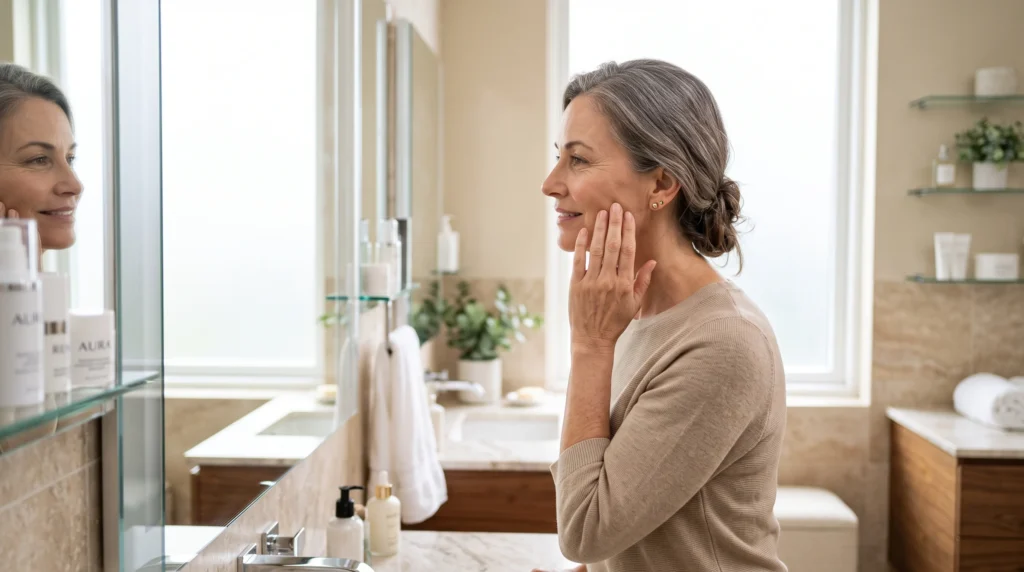
What else supports skin through menopause?
HRT is one lever, and it is far from the only one. Several approaches work on the same collagen and hydration deficit from the outside, and they can be used with or without hormone therapy depending on what someone is already doing.
Topical care carries much of the daily load. Retinoids prompt the skin to build collagen, and peptides support the same work. Humectants such as hyaluronic acid and glycerin then restore some of the water the dermis has stopped holding, while a steady, barrier-focused routine handles the dryness and sensitivity that tend to travel with the change.
In-office treatments reach deeper by nudging the skin to lay down new collagen. A couple fit the menopausal picture especially well:
- Energy-based skin tightening. Skin tightening treatments in Sylvania and Bloomfield Hills use radiofrequency to heat the dermis and stimulate fresh collagen, firming skin that has lost some of its structure.
- Collagen-stimulating treatments. RF microneedling in Sylvania and Bloomfield Hills pairs microneedling with radiofrequency to trigger remodeling deeper in the skin, while biostimulator injections in Sylvania and Bloomfield Hills prompt the body to generate its own collagen over the months that follow.
None of these rebuilds estrogen, so they address the visible structural loss rather than the hormonal cause behind it. Used alongside sun protection and a considered routine, they help skin hold its shape through a stretch when it would otherwise thin out. A consultation is where the mix gets matched to the skin in front of the provider.
What should you consider before starting HRT for your skin?
A few honest points help set expectations before treating skin as a reason to begin hormone therapy.
- Skin is rarely the primary reason to start. HRT is prescribed chiefly for menopausal symptoms and long-term health, with skin improvement as a welcome bonus. If skin is the only concern, topical and in-office options may cover it without systemic treatment.
- Timing and history shape the decision. How much HRT helps, and whether it suits you, depends on when it begins and on individual medical history, which is why the conversation belongs with a qualified provider rather than a checklist.
The short version The rapid skin change around menopause traces back to estrogen stepping away, which strips collagen and hydration far faster than the sun ever does. Sun protection still matters, though it does nothing for the hormonal side. HRT can restore some of that collagen for the right candidate, and treatments that stimulate collagen from the outside help whether or not hormone therapy is on the table. The starting point is knowing which process is driving the change, then matching the response to it. |
Frequently Asked Questions
Does menopause really age skin faster than the sun?
In the years right after menopause, yes. The drop in estrogen can remove up to about a third of the skin’s collagen within five years, a rate of loss that outpaces the slow, cumulative damage from ultraviolet exposure. Sun damage still adds up over a lifetime, but its pace is gentler than the menopausal drop.
Can HRT reverse skin aging?
HRT can rebuild some of the collagen the skin lost and bring back a measure of its firmness, and studies have measured those gains in women on estrogen therapy. It works best as part of a broader plan and for candidates a clinician has assessed. Keep in mind it is prescribed for menopausal health, with skin as a secondary benefit.
Is it too late to start if I am years past menopause?
That depends on individual factors a provider evaluates, since timing influences both benefit and risk. Even where systemic hormone therapy is not the right fit, collagen-stimulating treatments and a strong topical routine can still improve how the skin looks and feels.
What treatments help menopausal skin without hormones?
Radiofrequency skin tightening and RF microneedling both prompt the skin to build new collagen, and biostimulator injections do the same from within, while retinoids and hyaluronic acid support the skin topically. These work on the structural loss directly and can be combined for a fuller result.
Does topical estrogen cream help skin?
Applied to the skin, estrogen has been studied for a local lift in collagen and firmness without the systemic reach of an oral tablet or a patch. Suitability rests on the same medical review as any hormone treatment, so it is worth raising at a consultation rather than trying on your own.
Will sunscreen make a difference at this stage?
It will. Postmenopausal skin has less collagen in reserve, so protecting what remains matters more, not less. Daily broad-spectrum sunscreen guards against further collagen breakdown and keeps pigment changes down.
Final thoughts
The stretch of rapid skin change around menopause is not a personal failing or a sign of neglect. It is the predictable result of estrogen stepping back from work it had done quietly for decades. Seeing it that way turns a confusing shift into a solvable one, with hormone therapy for those it suits and collagen-focused treatments for everyone else. If your skin has changed faster than the calendar seems to warrant, the team at our med spa in Sylvania and Bloomfield Hills can help you sort the hormonal side from the sun side and build a plan that fits.
Book a consultation to talk it through.